
Why Your AWD Vehicle Requires a Flatbed Tow Truck to Prevent Permanent Transmission Damage
For many drivers in the Tri-State area, a breakdown on the side of the New Jersey Turnpike or a busy street in Elizabeth is a stressful ordeal. However, the stress of the breakdown can quickly pale in comparison to the financial nightmare of a botched recovery. As an industry veteran with Nick’s Towing Service, I have spent over 45 years providing service to the Tri-State Area’s largest logistics companies. I have seen firsthand the “AWD Trap” – a situation where a well-meaning driver calls for the closest tow truck company, only to have their sophisticated All-Wheel Drive (AWD) system destroyed by an improper wheel-lift tow. Many owners mistakenly believe their AWD vehicle can be treated like a standard Front-Wheel Drive (FWD) car. This assumption is a multi-thousand-dollar mistake. In this guide, we will explore why your vehicle’s mechanical health depends entirely on requesting a flatbed for your next tow.
Understanding the AWD Drivetrain: Why It’s Different from FWD or RWD
To understand why an affordable tow truck isn’t always a bargain if it uses the wrong equipment, you must understand what is happening beneath your floorboards. In a standard two-wheel-drive vehicle (FWD or RWD), the engine sends power to only one axle. The other axle’s wheels are “free-wheeling,” meaning they are not mechanically linked to the transmission’s internal gears. You can lift the drive wheels off the ground and let the free-wheeling ones spin indefinitely without causing damage.
An AWD system is a different beast entirely. In these vehicles, all four wheels are mechanically linked to the transmission through a series of differentials and a transfer case. Whether you drive a Subaru, an Audi Quattro, or a modern AWD SUV, the front and rear axles are “tied” together. This connection is what provides superior traction in NJ winters, but it is also the vehicle’s Achilles’ heel during a tow. The center differential or viscous coupling is designed to manage slight variations in wheel speed during cornering. It is not designed to handle the extreme speed differential created when one axle is held stationary while the other spins at 55 mph behind a tow truck company vehicle.
Data shows that in modern AWD systems, the mechanical linkage is constant. Even in “on-demand” systems that primarily use FWD, the driveshaft to the rear is often still spinning, and the internal clutches are engaged or submerged in fluid that requires active cooling. To keep your car healthy, you should also read about Top Auto Repair Tips to Extend Your Vehicle’s Lifespan to complement your knowledge of drivetrain safety. Understanding this mechanical bond is the first step in realizing why you must never allow an AWD car to be towed with any wheels on the pavement.
The Mechanics of Destruction: What Happens During a Wheel-Lift Tow
When you call a local tow truck and they arrive with a “wheel-lift” or “hook and chain” truck, they typically lift the front two wheels of the car, leaving the rear wheels on the ground. For an AWD vehicle, this is the start of a mechanical catastrophe. As the tow truck company begins to pull the vehicle, the rear wheels spin. Because the rear wheels are linked to the front axle via the center differential or transfer case, they attempt to force the front wheels to spin as well.
However, the front wheels are locked in the tow truck’s cradle. This creates an immediate, violent conflict within the drivetrain. The center differential tries to compensate for this 100% speed difference. Under normal driving, a differential might handle a 5% or 10% difference in wheel speed. A 100% difference generates friction and heat at an exponential rate. Furthermore, since the vehicle’s engine is turned off, the transmission’s internal oil pump is not functioning. In a modern automatic or CVT transmission, the oil pump is driven by the torque converter or the input shaft, which only spins when the engine is running.
Without the oil pump, there is no circulation of cooling fluid. The gears and clutch packs in the transfer case are essentially “running dry” while being forced to spin at highway speeds. Within just a few miles, the internal components reach temperatures high enough to melt seals, warp gears, and “cook” the transmission fluid. This is often the source of the dangerous truth about ignoring a grinding noise in your wheels – once that noise starts after a tow, the damage is likely already done. Towing an AWD with the driveshaft in and no axles pulled can result in a total transmission seizure within miles.
Why Flatbed Towing is the Industry Standard for AWD Safety
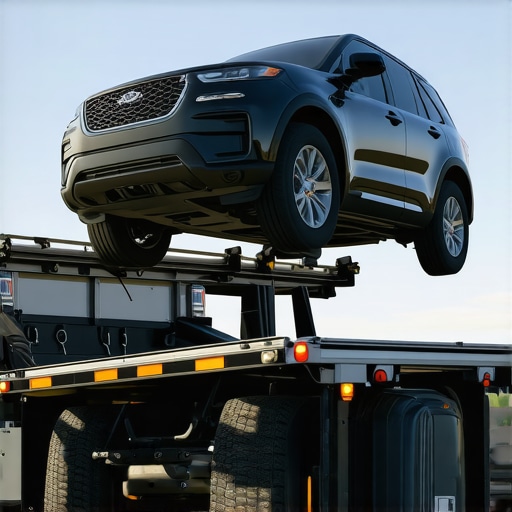
The solution to this mechanical nightmare is flatbed towing. A flatbed truck, also known as a “rollback,” features a large hydraulic platform that tilts to the ground. The vehicle is winched onto the platform so that all four wheels are completely stationary. Once the car is secured, the platform is leveled, and the vehicle is transported without a single component of the drivetrain moving.
This method eliminates 100% of the drivetrain stress. There is no friction, no heat buildup, and no risk to the center differential. This is why flatbed towing is recommended for luxury vehicles, AWD cars, and EVs because it provides 30% better protection despite the slightly higher cost. It is the only way to ensure that the complex electronics and mechanical couplings of a modern AWD system remain intact. If you are concerned about your transmission’s health after a long history of driving, you should learn how to save your transmission with a simple fluid exchange, as fresh fluid is your best defense against heat damage.
When you call for towing elizabeth or search for tow trucks near me, you must specify that your vehicle is AWD. Professional dispatchers at activatetowing.com will immediately recognize the need for a flatbed. It isn’t just about convenience; it’s about the physics of the vehicle. By keeping the wheels off the ground, you are protecting the delicate balance of the planetary gear sets and the viscous fluid that makes AWD possible.
The Real Cost of “Cheap” Towing: NJ Pricing and Repair Estimates
Many drivers are tempted to choose the most affordable tow truck available, often opting for a wheel-lift service because it might be $50 or $60 cheaper. In New Jersey, the pricing landscape for 2026 shows that a local tow typically runs between $100 and $190. For a flatbed tow in NJ, the average rate is approximately $170 for a 5-mile tow, which follows the state’s average rates of a $100 base fee plus roughly $4.50 per mile.
Contrast that $60 difference with the catastrophic cost of a drivetrain failure. Replacing a modern AWD transmission or a damaged transfer case can cost anywhere from $3,000 to $7,000 depending on the make and model. For high-end European brands, that number can easily climb higher. When you ask for a tow truck quote, you aren’t just paying for the transport; you are paying for an insurance policy against mechanical failure.
Choosing a tow truck company based solely on the lowest price is a gamble where the stakes are your vehicle’s mobility. A $170 flatbed service is an investment; a $110 wheel-lift service on an AWD car is a liability. Before you agree to any service, ensure you have performed Vehicle Diagnostics Explained: Easy Checks Before Your Road Trip so you know exactly what your car needs and can communicate it clearly to the operator.
Special Scenarios: When You Need More Than a Standard Tow
Not every situation is a simple breakdown on a paved shoulder. Sometimes, the closest tow truck company needs to provide specialized services. For instance, motorcycle towing requires specific cradles and tie-down points to ensure the bike doesn’t tip, which is a different set of risks than AWD towing but requires the same level of expertise.
In other cases, you might require an off-road towing service. If your AWD SUV is stuck in deep mud or snow off the beaten path, a flatbed might not be able to reach you. In these recovery scenarios, professional operators use “dollies.” Dollies are small sets of wheels placed under the tires that remain on the ground, effectively turning a wheel-lift tow into a four-wheels-up tow. This is a vital alternative when a flatbed is physically unable to access the vehicle.
Whether you need a flat tire tow truck or 24 hrs towing after a midnight collision, the technical requirements remain the same. If the operator at activatetowing.com or activatetowing.com suggests a wheel-lift for your AWD, you must insist on dollies or a flatbed. Even a flat tire tow truck service should be handled with care if the spare cannot be fitted and the vehicle must be moved.
Conclusion: Protecting Your Investment
In the world of automotive recovery, knowledge is your most valuable tool. While finding an affordable tow truck is a priority for many, the wrong towing method is never a bargain. As we have explored, the mechanical link between the axles of an AWD vehicle makes it uniquely vulnerable to the friction and heat of a wheel-lift tow. The “AWD Trap” can turn a minor mechanical issue into a total vehicle loss in a matter of miles.
Always be proactive. When you call for a tow truck quote, clearly state: “My vehicle is All-Wheel Drive and requires a flatbed.” This simple sentence can save you $7,000 in transmission repairs. For those in the Elizabeth area and throughout the Tri-State region, Nicholas F. Testa and the team at towing elizabeth are ready to provide the expert, 24/7 assistance your vehicle deserves. Don’t leave your drivetrain to chance; trust the experts who understand the mechanics of your car as well as you do. Visit activatetowing.com today for reliable, damage-free towing services.