

It was 6:45 AM on a Tuesday, the kind of morning where the frost is so thick you have to muscle the car door open just to get inside. I sat down, turned the ignition, and instead of the reassuring hum of my engine, I heard it: *click-click-click-click*. It sounded like a frantic telegraph operator was trapped under my hood trying to send a distress signal. My heart sank. I had a meeting in thirty minutes, and my reliable daily driver had suddenly decided to turn into a percussion instrument. I remember thinking, ‘This is going to cost me a fortune.’ We have all been there, staring at the dashboard in disbelief, hoping that if we just try one more time, the car will magically change its mind. Today, I’m going to walk you through exactly what that noise means so you can stop stressing and start fixing.
[image]
Stop Guessing and Start Listening to Your Starter
I’ll be the first to admit that I haven’t always been the ‘car guy’ in the neighborhood. Years ago, I made the expensive mistake of immediately buying a brand new starter motor the second I heard that clicking noise. I spent a whole Saturday afternoon scraped up and swearing under the chassis, only to realize that the problem was a $5 corroded battery terminal that just needed a bit of wire-brushing. It was a classic case of missing the forest for the trees. Using a few auto repair hacks early on could have saved me a hundred bucks and a lot of frustration. Most of the time, that clicking is just your car’s way of saying it’s hungry for more electricity. We need to look at basic vehicle diagnostics before we start throwing expensive parts at the problem.
Is a Rapid Click Just a Fancy Way of Saying I Need a New Battery?
You might be worried that the clicking is the sound of your engine seizing up or something equally catastrophic. I’ve seen people panic and think they need a whole new car when they hear that metallic tapping. Relax. According to the AAA, battery-related issues are actually the number one reason for roadside assistance calls, with their technicians responding to over 17 million battery failures every single year. It’s almost never a ‘dead engine’ situation—it’s usually just a power delivery hiccup that we can solve right in your driveway.
The Difference Between a Dead Battery and a Dying Starter
The sound you hear is usually the starter solenoid. It’s essentially a high-powered switch that connects your battery to the starter motor. When there isn’t enough power to hold that switch closed, it snaps back, tries again, and snaps back again—creating that rapid clicking. This happens frequently when your car battery dies every time it gets cold outside, leaving the solenoid starved for juice. Or, it might be a sneaky ground wire problem that mimics a bad starter motor by preventing the circuit from completing. If you hear just one single, loud ‘clack’ rather than a rapid fire, you might actually need to learn how to tell if your car starter is going bad. Have you ever been stuck in your driveway with nothing but a clicking sound to keep you company? Let’s figure out which part of your electrical system is acting up so we can get you moving again.
Clean Your Battery Terminals Before You Buy Anything
Before you even think about calling a tow truck, you need to get your hands dirty—just a little bit. That rapid clicking sound is usually the result of high resistance. Think of your battery cables as a garden hose; if the nozzle (your terminal) is clogged with calcium and lead sulfate deposits, the water (electricity) can’t get through to the engine. I remember helping a neighbor who was convinced her alternator was shot. I looked under the hood and saw about an inch of white, fuzzy crust on her positive terminal. I didn’t even have my toolbox with me, so I used a stiff wire brush I found in the garage to scrub it down to the shiny metal. Two minutes later, her SUV roared to life. If you want to avoid these simple traps, mastering some basic auto repair hacks can keep you from wasting money at the shop.
Grab Your Multimeter and Chase the Volts
If your terminals look clean but the clicking persists, it’s time to bring in some data. This is where the $20 tool every driver needs for basic electrical troubleshooting becomes your best friend. Set your multimeter to DC volts and touch the probes to the battery posts. You are looking for at least 12.6 volts. Anything less than 12.2 means your battery is essentially discharged. 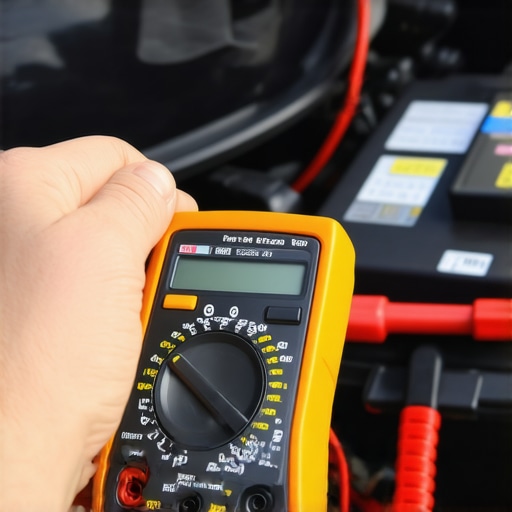 While you are at it, have someone try to crank the engine while you watch the display. If the voltage drops below 10 volts during that click-click-click, your battery lacks the cranking amps to push the starter. This often happens because of a parasitic battery drain that is slowly siphoning power while the car is off.
Watch Out for These Jump Starting Blunders
If the multimeter says the battery is low, a jump start is the fastest way to confirm the diagnosis. However, be careful; there is a common mistake people make when jump-starting a modern car that can fry expensive computer modules. Always connect the positive first, and for the final ground connection on the dead car, use a piece of unpainted metal on the engine block rather than the battery terminal itself. This provides a cleaner path for the electricity and avoids any potential sparks near the battery gas.
Check the Engine Ground to Save Your Sanity
What if the battery is perfect, but it still won’t start? This is the phantom problem that drives DIYers crazy. Your starter motor needs a complete circuit to work, which means the electricity must flow back to the battery through the car frame. If the engine ground strap is loose or rusted, it creates the exact same clicking noise as a dead battery. It is a classic ground wire problem that mimics a bad starter motor perfectly. Use your multimeter to check for voltage drop between the engine block and the negative battery terminal. If you see more than 0.2 volts while trying to start, you have found your culprit—a dirty wire, not a dead engine.
Why Your Solenoid Might Be the Real Villain
If your battery and grounds are solid, the focus shifts to the starter solenoid itself. Sometimes the internal copper contacts inside the solenoid get scorched over time. When this happens, you might get a single loud thunk or a series of weak clicks. You can sometimes bypass the solenoid with a screwdriver to see if the motor spins—a trick I have used on more than one old truck—but you have to be extremely careful not to touch the frame and cause a massive short circuit. This is why learning how to tell if your car starter is going bad is vital before you commit to the labor of pulling the whole unit out.
Stop Firing the Parts Cannon and Save Your Wallet
Let’s dig deeper into what happens when the basic checks don’t give you a clear answer. Many DIYers fall into the trap of the ‘parts cannon’—firing new components at a problem until it disappears. This is where decoding vehicle diagnostics becomes an art rather than a chore. People see a trouble code and assume it’s a replacement order, but codes only tell you that a circuit is out of range, not that a specific part is broken. #IMAGE_PLACE_HOLDER_C# For example, why your scanner says p0420 might not mean your catalytic converter is dead; it could be a simple O2 sensor or a tiny exhaust leak. In my years of turning wrenches, I have seen hundreds of people spend $800 on a converter when a $50 gasket would have done the job. According to research published by the Society of Automotive Engineers, misinterpreting diagnostic data is a primary driver of unnecessary parts replacement in the automotive industry.
Why Your Engine Taps Only After an Oil Change
Then there is the bizarre phenomenon of the post-maintenance noise. Why your engine makes a tapping noise only after an oil change often comes down to oil viscosity or the anti-drainback valve in a cheap filter. If you’ve just done a fresh swap and suddenly hear a rhythmic ‘tick-tick-tick,’ don’t panic and think your bearings are gone. Using the wrong weight is one of those auto repair hacks that backfires in cold weather, especially on modern engines with variable valve timing. Likewise, many people believe brake service is just about the pads. However, brake service myths busted reveals that ignoring the caliper slide pins and the quality of the brake hardware is what usually causes that annoying squeal, not the pads themselves. I also want to warn you about the truth about using cheap aftermarket sensors. Modern ECUs are incredibly sensitive to resistance levels. A generic mass airflow sensor might be 15% off-spec—enough to trigger a lean condition that ruins your gas mileage. Investing time into how advanced vehicle diagnostics prevent costly breakdowns means looking at live data streams, not just clearing codes and hoping for the best.
Is that ‘Safe Mode’ actually protecting your transmission?
When your car goes into ‘limp mode,’ it’s a failsafe designed to prevent catastrophic failure, but often it’s triggered by the solenoid failure that locks your car in limp mode rather than a mechanical internal disaster. Replacing the whole transmission is the nuclear option that many shops jump to, but checking the electrical harness and shift solenoids first can save you thousands. Have you ever fallen into this trap and replaced a major part only to find out it was a simple sensor? Let me know in the comments!
If you want to move beyond basic troubleshooting, you need to stop relying on the free code scans at the local auto parts store. Those tools give you a starting point, but they often leave out the ‘freeze frame’ data that tells you exactly what was happening when the fault occurred. Personally, I never go under the hood without a bidirectional scan tool. Unlike a basic reader, a bidirectional tool allows you to command the car’s computer to activate specific components, like cycling the ABS pump or testing an individual fuel injector. This is exactly how advanced vehicle diagnostics prevent costly breakdowns—by proving a part is actually faulty before you spend a dime. According to the Bosch Automotive Handbook (11th Edition), modern fuel management systems are so complex that a simple voltage drop can mimic a mechanical failure, making precision tools non-negotiable for the home mechanic. 
How do I maintain my vehicle’s health over several years?
Maintenance isn’t just about reacting to noises; it’s about a proactive data strategy. I keep a digital log of every fluid change and brake inspection because ‘feeling’ isn’t a measurement. When I perform the ultimate guide to brake service for safety and performance, I don’t just swap pads and call it a day. I use a copper-based anti-seize on the hardware and check the moisture content of the brake fluid with a dedicated pen tester. High moisture leads to internal corrosion of the ABS module—a $1,500 mistake you can avoid for the price of a $10 bottle of DOT 4. This is one of those essential auto repair strategies for frequent drivers that separates the high-mileage heroes from the people constantly stuck on the shoulder.
AI and Telematics Are Transforming Your Driveway
Oil change innovations technologies that save your engine already include sensors that measure the actual chemical breakdown of the oil rather than just counting miles or engine hours. In the next decade, I expect we’ll see more integrated AI that cross-references your specific driving habits with global fleet data to warn you that a wheel bearing is 500 miles from failing. While it sounds like science fiction, the infrastructure is already being built into modern OBD-III proposals. We are moving toward a world where your car will predict its own failures before you even see a light on the dash.
Grab These Specific Tools to Beat Rust and Corrosion
One thing that hasn’t changed is the physical reality of metal-on-metal frustration. If you find yourself snapping a rusted fastener while trying to reach a sensor, you need to know how to remove a broken bolt without losing your mind. It’s a rite of passage for every DIYer, but it doesn’t have to ruin your week. My secret weapon is a set of high-quality cobalt left-handed drill bits; they often catch the bolt and spin it out during the drilling process itself. Don’t wait until you’re stranded on a Sunday night with a sheared bolt and a 7:00 AM meeting the next morning. My challenge to you is to check your battery’s resting voltage with a multimeter tonight—it’s the simplest way to see if you’re headed for a ‘click-click-click’ morning of your own.
What My Greasiest Knuckles Taught Me
Over the years, I have realized that successful auto repair is 90% patience and 10% actually turning a wrench. One of the biggest lightbulb moments I ever had was realizing that a ‘bad’ component is often just a victim of a bad environment—like a perfectly good starter being choked by a rusted ground wire. I also learned to trust my ears more than my ego; that specific rhythm of the click tells a story if you are quiet enough to listen. Finally, never underestimate the power of a simple cleaning. Half the ‘dead’ batteries I have encountered just needed the terminals scrubbed. Following top auto repair tips to extend your vehicles lifespan usually starts with these tiny, free maintenance habits that most people ignore until it is too late.
The Gear That Stops Me From Guessing
If you are serious about avoiding the tow truck, you need a few non-negotiables in your trunk. First, ditch the cheap plastic jumper cables and invest in a portable lithium-ion jump starter; it is significantly safer for your modern electronics and does not require a second car to get you moving. I also swear by a dedicated battery load tester—it tells you the actual health of the battery cells, not just the surface charge. For those who want to dig deeper, I always recommend keeping a vehicle-specific service manual in your garage rather than just relying on random videos. [image] Combine that with vehicle diagnostics explained easy checks before your road trip, and you will have a roadmap for almost any electrical gremlin that comes your way.
Take Back Control of Your Driveway
Mechanical issues can feel like a personal attack when you are already running late, but you now have the tools and the knowledge to face that clicking noise head-on. You are not just ‘fixing a car’; you are building the self-reliance to handle the unexpected without panicking. By applying these essential auto repair strategies for frequent drivers, you turn a potential breakdown into a minor weekend project. Don’t let a little bit of copper corrosion or a loose connection stand between you and your destination. Your car is a machine, and machines can always be mastered. Have you ever spent hours troubleshooting a click only to find it was something incredibly simple like a loose fuse or a dirty wire? Let me know in the comments below!