
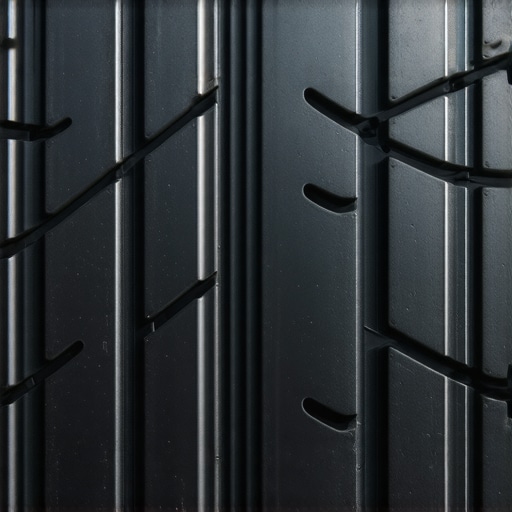
I felt it before I saw it. A rhythmic thump-thump-thump that got louder the faster I drove on the freeway. At first, I thought it was just a loose wheel weight or maybe a bit of mud stuck in the rim. But when I pulled over and ran my hand along the tread of my Michelin’s, my heart sank. It felt like a mountain range. There were distinct “cups” or scalloped dips carved into the rubber every few inches. I was frustrated because I’d just had a professional [vehicle diagnostics](https://repairmycarpro.com/vehicle-diagnostics-explained-easy-checks-before-your-road-trip) check done, and they told me my alignment was laser-straight. That’s when I realized I was looking at a classic case of dead shocks masquerading as a tire problem. Today, I want to help you avoid the mistake I made—throwing money at alignments when your suspension is actually the culprit. We’re going to dive into why this specific wear happens and how it differs from a [steering rack failure that feels exactly like a bad alignment](https://repairmycarpro.com/the-steering-rack-failure-that-feels-exactly-like-a-bad-alignment). Have you ever looked at your tires and thought they looked more like a topographical map than a piece of rubber? Drop a comment below if you’ve been chasing a vibration that won’t go away.
When Your Brand New Tires Start Making That Wavy Pattern
The most frustrating part about tire cupping—that scalloped, wavy look—is that it usually happens to the best of us when we think we’re doing everything right. You might have just finished some [essential auto repair strategies](https://repairmycarpro.com/essential-auto-repair-strategies-for-frequent-drivers) and think you’re in the clear. But here is the reality: your tires are essentially the messengers for the rest of your car. When your shocks or struts are dead, they lose the ability to keep the tire firmly pressed against the road. Instead, the tire starts to bounce, ever so slightly, like a high-speed basketball. Every time it hits the pavement after a tiny bounce, a little bit of rubber gets scrubbed off. Over thousands of miles, those tiny impacts create the scalloped dips you see now. It’s often accompanied by a [loud humming noise](https://repairmycarpro.com/why-your-tires-are-making-a-loud-humming-noise) that makes you think your wheel bearings are shot. I once spent an entire Saturday replacing a bearing only to find out it was the tire all along. Talk about a face-palm moment.
Is it really my shocks if the car still feels smooth?
This is the biggest hurdle for most DIYers and car owners. You expect a car with bad shocks to feel like a boat in a storm, but modern gas-charged struts can fail internally while still providing a decent ride quality. However, they can no longer control the “tire oscillation.” According to the experts at Monroe Shocks and Struts, a single worn shock can increase your stopping distance by up to 10 feet at 50 mph, which is a terrifying thought when you realize the wear is often invisible until you see it on the tread. If you’ve noticed that your [suspension squeaks like a rusty gate over speed bumps](https://repairmycarpro.com/why-your-suspension-squeaks-like-a-rusty-gate-over-speed-bumps) or you hear a [clunking sound over speed bumps](https://repairmycarpro.com/the-clunking-sound-you-hear-when-driving-over-speed-bumps), the cupping is likely already starting. You aren’t just losing rubber; you’re losing the very thing that keeps you glued to the asphalt.
Diagnose the Bounce Before Your Tires Turn into Saw Blades
To stop the scalloping, you have to find exactly where the suspension is failing to keep the rubber on the road. I like to start with the most basic “parking lot test” that any driver can do. Walk to each corner of your car and push down hard on the fender with all your weight. A healthy strut should bounce once and immediately settle. If your car keeps oscillating like a bowl of Jell-O, your damping is gone. This is the exact same lack of control that causes [the tire wear pattern that reveals a bent control arm](https://repairmycarpro.com/the-tire-wear-pattern-that-reveals-a-bent-control-arm) or cupping. Think of your shock absorber like a screen door closer; if that hydraulic pressure is gone, the door just slams—or in this case, the tire just slams into the pavement thousands of times per minute.
Look for the Tell-Tale Sign of Hydraulic Failure
Sometimes the bounce test isn’t enough because the spring is still stiff. You need to get a flashlight and look behind the tire at the strut or shock body itself. If you see a thick, grimy layer of oil and dirt caked onto the shaft, that shock has “given up the ghost.” The internal seals have failed, and the fluid that provides the resistance is now decorating your wheel well. I remember working on an old SUV where the owner swore the ride was fine, but [the clunking sound you hear when driving over speed bumps](https://repairmycarpro.com/the-clunking-sound-you-hear-when-driving-over-speed-bumps) was actually the metal piston bottoming out because there was zero fluid left to cushion the blow. Using [top auto repair tips to extend your vehicles lifespan](https://repairmycarpro.com/top-auto-repair-tips-to-extend-your-vehicles-lifespan) means catching these leaks before the tire tread is completely sacrificed. #IMAGE_PLACE_HOLDER_B#
The Hand Rub Technique to Identify Cupping Early
Before you can see the dips with your eyes, you can feel them with your palm. Carefully run your hand over the tread in both directions. If it feels smooth one way but sharp or “toothy” the other way, you’re looking at heel-toe wear or early cupping. This is often where people get confused and assume they just need a [brake service](https://repairmycarpro.com/the-ultimate-guide-to-brake-service-for-safety-and-performance) because of a slight vibration. But if the vibration doesn’t change when you hit the pedal, it’s almost certainly the tire’s physical shape. I once spent $400 on new rotors for a client who insisted his brakes were warped, only to find out his rear shocks were so dead they had turned his rear tires into 12-sided polygons.
Why a Standard Alignment Might Miss the Real Issue
You can have a car that is perfectly aligned on a static machine, but the moment you hit 60 mph, the dynamic forces take over. If your bushings are torn or your struts are weak, that “perfect” alignment disappears under load. This is why [how advanced vehicle diagnostics prevent costly breakdowns](https://repairmycarpro.com/how-advanced-vehicle-diagnostics-prevent-costly-breakdowns) is so critical. A tech needs to check the play in your ball joints and control arms while the car is loaded. If you find a worn component, you can often use [auto repair hacks to save money without sacrificing quality](https://repairmycarpro.com/auto-repair-hacks-save-money-without-sacrificing-quality) by replacing just the bushing instead of the entire arm, provided you catch it before the metal-on-metal damage starts.
Stop masking the problem with frequent tire rotations
Most car owners are taught that the key to longevity is the 5,000-mile rotation. It is a cornerstone of essential auto repair strategies. However, here is a contrarian take that might ruffle some feathers: frequent rotations can actually hide a terminal suspension failure until it is too late. When you move a tire that has just started to cup from the rear to the front, you are essentially erasing the crime scene. By the time you notice the vibration through the steering wheel, you have likely sacrificed all four tires to a set of shocks that should have been replaced years ago. While we look for oil change innovations to save our engines, we often ignore the simple mechanical dampening that saves our rubber.
The trap of ignoring your wheel’s unseen bounce
A common mistake is assuming that if the car doesn’t feel like a pogo stick, the struts are fine. This is the ‘Oops’ factor that costs thousands. Modern suspension systems are incredibly good at masking low-frequency bounces (the big dips in the road), but they can completely lose their ability to control high-frequency oscillations. According to the Tire Industry Association (TIA), ‘uncontrolled wheel assembly resonance’ can occur even if the car feels stable, where the tire micro-bounces thousands of times per mile. This isn’t just a tire pressure mistake; it is a failure of the hydraulic valving inside your strut. If you wait until the car feels ‘bouncy’ to take action, you have already passed the point of no return for your tread depth.
Does a bad brake caliper really ruin your tread?
It sounds unrelated, but a sticking brake caliper is a silent killer of tires. When a caliper doesn’t fully retract, it generates immense heat that can eventually degrade the grease in your hub assembly. Once that grease thins out, you get microscopic wheel play. This play allows the tire to ‘wobble’ just enough to start the cupping process. This is why brake service myths busted often focus on hardware, not just pads. You might see a strange brake fluid color and think it is just an age issue, but it could be a sign of the heat that is currently cooking your wheel bearings and, by extension, your tires. #IMAGE_PLACE_HOLDER_C#
Look beyond the visual inspection for real answers
To truly diagnose why your tires are scalloping, you have to look for the ‘ghost’ in the machine. Sometimes, the issue isn’t a leak or a bounce, but a worn bushing that only fails under the stress of a turn. I always suggest that drivers learn how to spot a bad ball joint using a floor jack because a visual check on a lift often masks the play that occurs when the car’s weight is actually shifting. Following top auto repair tips to extend your vehicles lifespan means being proactive about these hidden mechanical tolerances. Have you ever fallen into this trap where you replaced the tires only for the noise to come back a month later? Let me know in the comments below.
Precision Tools Save Your New Parts from Early Failure
I used to think a ‘tight’ bolt was just a ‘tight’ bolt, but that mindset is exactly why I once stripped a subframe mount on a late-model sedan. When you are dealing with modern suspension systems, especially those with aluminum control arms, you absolutely must use a calibrated torque wrench. I personally rely on a split-beam torque wrench because it doesn’t need to be turned back to zero after every use, which maintains its accuracy over years of shop abuse. If you are trying to use auto repair hacks to save money without sacrificing quality, the one place you shouldn’t skimp is on your diagnostic gear. For example, using a bidirectional scan tool allows you to perform ‘active tests’ where you tell the car’s computer to cycle a solenoid while you’re checking for physical movement. This is how advanced vehicle diagnostics prevent costly breakdowns by revealing if a component is electronically functional but mechanically seized. Technical data from the engineering team at Moog Chassis Parts indicates that even a small deviation in mounting torque can lead to premature bushing tearing and uneven tire wear.
How can I make my suspension components last for the life of the car?
The secret to extreme longevity isn’t just buying expensive parts; it is managing the environment they live in. Every time I perform a check-up, I look for oil change innovations and take a moment to apply silicone-based lubricants to the rubber bushings. This prevents the rubber from drying out and cracking, which is the root cause of those annoying squeaks. You should also be following top auto repair tips to extend your vehicles lifespan by cleaning your wheel wells after driving through salt or mud. Road grime acts like sandpaper on your shock seals, and keeping those shafts clean ensures the damping stays consistent for years longer than average. #IMAGE_PLACE_HOLDER_D#
Anticipate the Failures Before They Cost You a Fortune
We are rapidly moving toward a world where your car will tell you when a strut is failing before you ever feel a bounce. I predict that within the next five years, onboard telematics will use accelerometer data to compare your current ride quality against factory benchmarks in real-time. Until that becomes standard, you have to be the computer. Use your phone to record a slow-motion video of your wheel while driving over a speed bump—it is a clever way of decoding vehicle diagnostics at home. If you see the wheel ‘chatter’ or bounce more than once after the impact, your damping is officially toast. My challenge for you is to get under your car with a good LED work light and perform a ‘stress test’ on your bushings with a pry bar. You might be surprised at what you find before it ruins your next set of expensive tires.
Lessons My Wallet Taught Me After 20 Years of Wrenching
I once thought premium tires were invincible until I ignored a minor bushing rattle and ruined an expensive set of Michelin tires in under six months. The biggest takeaway from my years under the lift is that suspension wear is almost always cumulative. If your front left strut is blown, your front right is likely at 10% life remaining; always replace these components in pairs to maintain predictable handling. Don’t fall into the ‘parts cannon’ trap of replacing every arm and link you see. Instead, rely on systematic decoding vehicle diagnostics to pinpoint the exact failure. Remember that silence is deceptive; a strut can be quiet and still fail to control the oscillation of your wheel, leading to that dreaded scalloped tread. Trust your hands more than your eyes; if the tread feels ‘toothy’ when you rub it, your suspension is already losing the battle.
The Reliability Stack I Keep in My Garage
To stay ahead of tire wear, I personally rely on a few specific tools that provide more accuracy than a simple visual check. First, a digital tread depth gauge is essential for catching the early stages of cupping before they become a roar on the highway. I also highly recommend keeping a physical copy of a Haynes or Chilton service manual for your specific make and model. These books contain the exact torque specifications that ensure your new parts don’t vibrate loose. Finally, a high-lumen LED work light is your best friend for spotting the ‘wet’ film of a leaking shock absorber. Tracking these details is part of the top auto repair tips to extend your vehicles lifespan that I’ve shared with hundreds of clients over the years.
#IMAGE_PLACE_HOLDER_E#
Take Control of Your Commute Again
Don’t let a vibrating steering wheel or a thumping tire steal the joy of your daily drive. When you master auto repair hacks to save money without sacrificing quality, you transform from a passive driver into the lead engineer of your own safety. Performing a thorough vehicle diagnostics check every few months is the secret to a car that lasts 300,000 miles. You have the tools and the knowledge to stop the bounce and save your rubber. Have you ever found a strange wear pattern on your tires that stumped your local shop? Let me know your story in the comments below!