

I remember it vividly—the first time I took my old sedan out for a spirited drive after a long winter. I stomped on the pedal to merge onto the highway, and within seconds, my cabin smelled like a carton of eggs left in the sun for a week. I actually stopped and checked my floor mats to see if a grocery bag had rolled under the seat. Nothing. It was coming from the vents, and it was visceral. I made the classic rookie mistake of thinking it was just a dirty cabin filter and threw twenty bucks at a new one, hoping for a miracle. It didn’t help. I felt embarrassed every time I had a passenger. I’d try to accelerate gently, hoping to avoid triggering the ‘sulfur ghost,’ but that’s no way to drive. Today, I’m going to help you skip that frustration and get straight to the root of why your car smells like rotten eggs during acceleration so you can stop holding your breath every time you pass a slow truck.
Stop Ignoring the Sulfur Cloud Following You
Usually, that stench is a cry for help from your exhaust system. When I first dealt with this, I was terrified my whole engine was failing. I started decoding vehicle diagnostics on my own and realized that a smell this specific is almost always tied to your catalytic converter or your fuel system. It’s a chemical reaction gone wrong. When your engine runs too rich—meaning there is too much fuel and not enough air—the excess fuel hits the hot catalytic converter and creates that unmistakable hydrogen sulfide gas. According to the Environmental Protection Agency (EPA), your catalytic converter is specifically designed to neutralize these gases into odorless sulfur dioxide, but when it’s overwhelmed or physically broken, the process fails. Have you ever felt that sudden surge of panic when a weird scent fills your car right as you’re trying to get somewhere important? It’s a specialized kind of stress.
Does this mean my engine is toast?
Not necessarily, but it definitely means you shouldn’t wait. I know what you’re thinking: ‘Maybe if I just use higher octane gas, it’ll go away.’ Believe me, I tried that too. I spent two weeks topping off with the expensive stuff, hoping the smell would just evaporate into the ether. It didn’t. It just made my wallet lighter while the car continued to stink up the neighborhood. If you’re skeptical about whether a smell can really indicate a mechanical failure, just remember that your car is a giant chemistry experiment on wheels. A clogged catalytic converter can eventually lead to your car stalling out or failing to start entirely. Early on, I ignored the smell because I was worried about a massive repair bill that I couldn’t afford at the time. I learned the hard way that finding some auto repair hacks to save money is much easier when you catch the problem before it leaves you stranded on the shoulder of a busy highway. It might be as simple as a failing fuel pressure regulator or even an old battery that’s overcharging and boiling its acid. In the next section, we’re going to walk through the three most likely culprits so you can narrow it down without an expensive trip to the shop just for a peek.
How to Pinpoint the Stink Without a Mechanic
To stop the smell, you have to find the leak in the chemistry. Most people assume the catalytic converter is dead on arrival, but it’s often just the victim of a crime committed elsewhere in the engine. Think of the converter like a high-tech sponge. If you pour clean water on it, it works fine. If you dump a bucket of sludge, it clogs and starts to rot. When you’re decoding vehicle diagnostics, you aren’t just looking for broken parts; you’re looking for why they broke. I remember a specific Saturday afternoon spent under my cousin’s beat-up SUV. We were convinced the converter was toast. After wrestling with a rusty bolt for an hour—and losing a fair bit of skin on my knuckles—we realized the converter was actually clear. The rotten egg smell was coming from a leaking fuel injector that was saturating the exhaust with raw gas. It was a messy, gas-soaked realization that taught me to check the simple stuff first.
Start with the Catalytic Converter Temp Test
You don’t need a degree in engineering to check this. If you have an infrared thermometer, you can check the temperature before and after the converter. If the outlet side isn’t significantly hotter than the inlet side, the chemical reaction isn’t happening. This is one of the most essential auto repair strategies for frequent drivers because it tells you immediately if the part is failing. However, be careful. Sometimes your scanner says P0420 but the converter is actually fine; it might just be a lazy oxygen sensor lying to the computer. 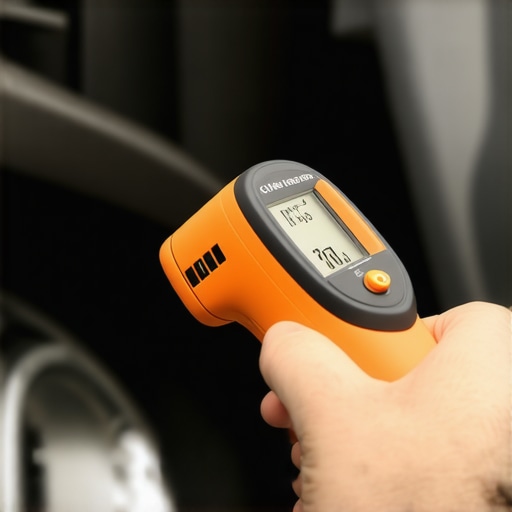
Check for a Fuel System Gone Rogue
If the converter checks out, your engine is likely running rich. This is the automotive equivalent of over-watering a plant. The excess fuel can’t burn in the cylinders, so it is pushed into the exhaust where it creates that nasty hydrogen sulfide gas. You should investigate your fuel pressure regulator. When these fail, they often leak fuel directly into the vacuum line. I once diagnosed this by simply pulling a vacuum hose; gas literally dripped out of it. If you suspect your fuel system is the culprit, knowing how to tell if your fuel pump is dying or if your regulator is shot can save you from a thousand-dollar converter replacement that wouldn’t have fixed the problem anyway.
The Battery Acid Trap You Might Miss
This is the wild card of the rotten egg world. If your alternator’s internal regulator fails, it might start pumping 15 or 16 volts into a 12-volt battery. This overcharges the battery, causing the liquid electrolyte inside to boil. Since that liquid is sulfuric acid, it releases a gas that smells exactly like rotten eggs. I once had a client who replaced their exhaust twice because of the smell, only to find out their battery was minutes away from exploding because the alternator was going haywire. Learning how to tell if your car alternator is overcharging the battery with a simple multimeter can save you a massive headache and a very dangerous mess under the hood.Most car owners think that once the sulfur smell starts, it’s a death sentence for the catalytic converter. But here’s the contrarian truth: in my experience, the converter is often just the messenger. If you keep replacing it without fixing the underlying fuel mixture or ignition issue, you’re just throwing money into a furnace. This is where how advanced vehicle diagnostics prevent costly breakdowns becomes your best friend. Instead of guessing, you need to look at the live data on your scanner. I have seen countless DIYers replace a perfectly good sensor simply because they didn’t understand that a code only identifies a circuit, not necessarily a part.
Stop Treating Your Scanner Like a Magic Wand
I’ve seen too many people fall into the trap of buying economy parts to fix a complex code. The truth about using cheap aftermarket sensors in your engine is that their resistance values are often slightly off-spec. The computer sees this as a fault, and you’re right back where you started with a check engine light and a smelly exhaust. One of the biggest ‘oops’ factors is ignoring the electrical health of the car. For instance, the ground wire problem that mimics a bad starter motor can also wreak havoc on your sensor readings. If the sensor cannot find a clean ground, it sends a noisy signal to the ECU, which might then dump too much fuel into the engine, creating that unmistakable rotten egg smell. 
Is Your Oil Choice Actually Poisoning Your Exhaust?
It sounds extreme, but your choice of lubricant directly impacts your exhaust health. Many people believe that oil is just oil as long as it is changed on time. However, according to a technical report by SAE International, modern engines using oil with high phosphorus or sulfur additives can actually poison the precious metals inside your catalytic converter if the engine consumes even a tiny amount of lubricant. This is why the mistake of using the wrong oil viscosity in cold weather is so dangerous; it increases internal wear and allows more blow-by gases to contaminate the catalyst. Always check the API rating on the back of the bottle to ensure it is catalyst-compatible. Have you ever fallen into this trap where you replaced a part only for the problem to come right back? Let me know in the comments! Shifting your focus from part replacement to system analysis is one of the most essential auto repair strategies for frequent drivers today.One of the most important lessons I’ve learned is that your toolbox is your best defense against predatory repair shops. If you really want to dive deep, you need to stop thinking about your car as a collection of parts and start seeing it as a series of interconnected systems. This is why I always tell people that the $20 tool every driver needs is a high-quality digital multimeter. I use mine for everything from verifying sensor grounds to how to find a parasitic battery drain that’s been killing my battery overnight. Without this, you’re just guessing, and guessing gets expensive quickly. According to the Bosch Automotive Handbook (11th Edition), even a slight misfire that goes undetected can increase the temperature of your catalytic converter by several hundred degrees in minutes, leading to permanent sintering of the precious metal substrates. That’s essentially a fancy way of saying your expensive exhaust part melts from the inside out because you didn’t catch a simple spark plug issue.
How do I maintain my exhaust health over time?
Consistency is your only real friend here. I’ve found that the best way to keep that rotten egg smell away is to perform easy vehicle diagnostics checks before every road trip. This isn’t just about the exhaust; it’s about the entire health of the engine. I make it a habit to check my fuel trims once a month using a basic OBD2 scanner. If those numbers are creeping more than 10% in either direction, I know I have a vacuum leak or a fuel delivery issue long before the check engine light even thinks about turning on. #IMAGE_PLACE_HOLDER_D#
Stop Relying on Luck for Long-Term Results
In the future, I expect vehicles to become even more sensitive to minor fluctuations in sensor data as emission standards tighten. We are already seeing cars that won’t even start if the computer detects a minor leak in the evaporative system. This means that extending your vehicle’s lifespan will eventually require you to be more of a data analyst than a wrench-turner. I’ve started using advanced vehicle diagnostics to prevent costly breakdowns by logging my car’s performance over several months. It might sound overkill, but knowing what ‘normal’ looks like for your specific engine is the only way to spot ‘abnormal’ before it leaves you stranded. If you want to take control of your car’s health today, go out and buy a basic multimeter and learn to check your own battery voltage while the engine is running. It takes two minutes and could save you from the sulfur smell and a dead alternator in one go.
Lessons Learned from the Sulfur Ghost in My Driveway
Looking back at my first struggle with a stinky car, I realized that I was reacting out of fear rather than logic. Here are a few hard truths I had to learn the expensive way. First, the battery is the easiest check you’ll ever do, yet it’s the one most people skip. If I had known how to tell if your car alternator is overcharging the battery early on, I would have saved weeks of frustration. Second, don’t trust your nose alone. Smells tell you a system is failing, but they don’t always point to the specific component. Finally, realize that the truth about using cheap aftermarket sensors in your engine is usually a tale of “you get what you pay for.” Precision matters when you’re trying to balance fuel and air.
My Personal Survival Kit for Engine Troubleshooting
If you want to stop guessing and start fixing, you need a few core items in your garage. I never go under the hood without the $20 tool every driver needs—a reliable multimeter. It’s the only way to perform how to find a parasitic battery drain or verify sensor grounds accurately. I also recommend a basic OBD2 scanner that shows live data; being able to see your fuel trims in real-time is like having X-ray vision for your engine. Lastly, keep a can of mass air flow sensor cleaner handy. It’s a cheap preventative measure that can keep your fuel mixture lean and your exhaust clean.

Take Control of Your Car’s Health Today
You don’t have to be a master technician to keep your vehicle running smoothly. By paying attention to small signs like that sulfur scent and using top auto repair tips to extend your vehicle’s lifespan, you can avoid the major headaches that leave most drivers stranded. Now that you know exactly why your car smells like rotten eggs during acceleration, you can approach the repair with confidence instead of dread. Your car is a complex machine, but with the right data and a little patience, you can master it.
Have you ever spent money on a new part only to realize the real culprit was a simple $5 fix? Let me know in the comments below!