
I’ll never forget the rainy Tuesday I spent wrestling with a rusted-on lug nut on my old Silverado. I was stranded, frustrated, and decided to use a six-foot fence pipe as a makeshift cheater bar. One loud, sickening snap later, I wasn’t just dealing with a flat tire; I had a sheared-off wheel stud and a much more expensive repair on my hands. It was a classic rookie mistake that taught me a valuable lesson: brute force is usually the enemy of a successful repair. We have all been there, standing on the tire iron, praying the nut breaks loose before the metal gives way. When you are dealing with years of corrosion or a shop that went overboard with an impact wrench, that lug nut feels like it is welded to the car. If you force it too hard, you are looking at a major mechanical headache. Today, I am going to share the techniques that seasoned mechanics use to coax these stubborn nuts off without a trip to the parts store for a new stud.
Save Your Studs with Smart Physics Not More Muscle
Brute force is tempting when you are in a rush, but metal has a physical breaking point that does not care about your schedule. According to structural experts at ASM International, the tensile strength of a standard wheel stud can be significantly compromised by extreme torque, especially when combined with the structural weakening caused by hydrogen embrittlement or surface rust. Instead of just pulling harder, we need to work smarter. This starts with proper lubrication and, occasionally, a bit of thermal expansion. If you have been putting off your regular brake service, you might find your lug nuts are even more prone to seizing due to road salt and constant heat cycles.
Can a Little Penetrating Oil Really Solve This Nightmare?
Early in my DIY career, I ignored the signs of a badly seized bolt and ended up cross-threading it by trying to back it out dry. I thought I could just power through the resistance. That mistake cost me a whole Saturday and fifty bucks I did not want to spend on a new hub assembly. Nowadays, I reach for a high-quality penetrant and a torch before I ever reach for the heavy-duty breaker bar. It is about saving the stud, not winning a test of strength against a machine. Have you ever felt that terrifying pop when a bolt breaks instead of turns? We are going to look at the exact soak-and-heat method that has saved my knuckles more times than I can count. By understanding how the metal reacts to temperature and chemical intervention, you can get even the most stubborn nut moving freely. Before you grab your jack and head out to the driveway, let us talk about why your vehicle diagnostics might actually start with how hard it is to get your wheels off in the first place.
Force the Metal to Move Your Way
When a lug nut refuses to move, it is usually because of a chemical bond called iron oxide—rust—that has effectively fused the threads together. To break this bond without snapping the stud, we need a three-pronged attack: chemistry, heat, and vibration. Think of the rust like a dried-on glue; you cannot just pull it apart, you have to soften the glue first. This approach is essentially the secret to removing a rusted bolt without snapping the head, and it applies perfectly to wheel hardware. If you try to skip these steps, you risk a catastrophic failure that could leave your vehicle immobilized.
Let the Penetrant Do the Heavy Lifting
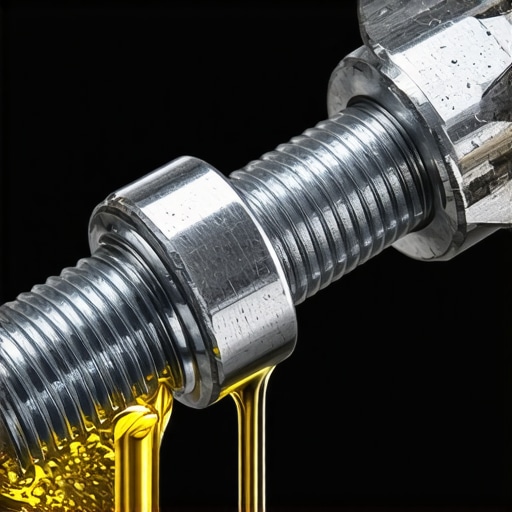
Patience is the most important tool in your kit. Before you even fit a socket to the nut, saturate the area with a dedicated penetrating oil. These are not standard lubricants; they are thin, high-solvent liquids designed to crawl into microscopic gaps through capillary action. I usually spray the nuts, then go have a coffee. I learned this the hard way while helping a friend with a 20-year-old farm truck. We sprayed the studs, waited twenty minutes, and the nuts that previously would not budge even with a four-foot bar suddenly gave way with a simple ratchet. Giving the oil time to work prevents the metal-on-metal friction that leads to stripped threads and expensive hub replacements.
Apply Heat Without Melting Your Hub
If the oil alone does not do the trick, it is time to introduce thermal expansion. By heating the lug nut with a propane torch, you cause the nut to expand at a slightly different rate than the stud inside it. This microscopic movement is often enough to crush the rust crystals and break the seal. Using a torch is one of those essential auto repair strategies for frequent drivers who deal with salt-covered roads every winter. Aim the flame at the flats of the nut, not the center of the stud, and keep it moving to avoid damaging the wheel finish or the rubber valve stem nearby. 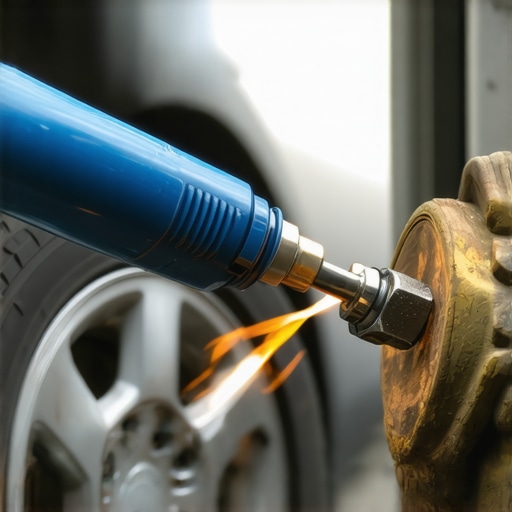
Shock the Threads Loose
Vibration is the final piece of the puzzle. Once the nut is hot and soaked in oil, take a heavy hammer and give the end of the lug nut—or the socket once it is placed—several sharp taps. This is not about brute strength; it is about sending a shockwave through the threads. This shocks the rust bond into failing instantly. Mechanics often use an impact wrench for this very reason—the rapid-fire hammering action of the tool is more effective than a steady, heavy pull. Integrating these steps into your routine is as vital as knowing how advanced vehicle diagnostics prevent costly breakdowns. It turns a potential disaster into a manageable afternoon task. If you have been ignoring a wobble or wondering why your steering wheel vibrates only when you hit the brakes, getting those wheels off safely is the first step toward a real fix.
It is easy to think that once the nut is off, the hard part is over. But honestly, the way you put your wheels back on is just as important as how you got them off. I have seen guys at the shop zip lug nuts on with a high-powered impact wrench until the socket screams, and then they wonder why the rotors warp six months later. In reality, that uneven pressure is a silent killer for your braking system. If you have ever wondered why your brake pedal vibrates when you stop on a hill, it might not be the pads at all—it could be the way your wheels were last installed. Precision is what separates a DIYer from a seasoned pro.
Stop Treating Your Lug Nuts Like They Owe You Money
The biggest myth in the DIY world is that ‘tight is right.’ Many people think applying a bit of anti-seize lubricant to the wheel studs will make the next job easier. However, according to engineering standards from SAE International, torque specifications are strictly calculated for dry threads. When you lubricate those studs, you reduce friction so much that your torque wrench will not click until you have actually over-stretched the metal beyond its elastic limit. You are effectively turning your lug nuts into a hydraulic press that can crush your brake disc or even snap the stud while you are driving. It is not about how much muscle you have; it is about staying within the manufacturer’s engineered tolerances. 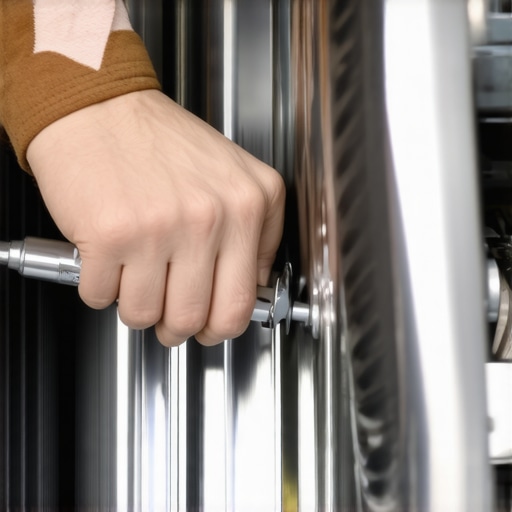
Is Your Mechanic Using an Impact Wrench as a Shortcut?
If you take your car in for a brake service and the technician does not use a manual, calibrated torque wrench for the final pass, you are asking for trouble. This lack of precision leads to ‘lateral runout,’ which is a technical way of saying the rotor is not sitting perfectly flat against the hub. Even a microscopic wobble will cause the pads to hit the rotor unevenly, creating heat spots that ruin your stopping power over time. This is why how advanced vehicle diagnostics prevent costly breakdowns involves checking physical runout, not just scanning computer codes. Have you ever fallen into this trap where a simple tire rotation led to a vibration you could not explain? Let me know in the comments.
The Hidden Danger of the Double Gasket Disaster
Moving from wheels to the engine bay, the ‘oops’ factor is often found in the most routine maintenance tasks. Take the common oil change. You might be following the synthetic oil myth that costs you fifty dollars every visit, but the real danger is the old oil filter gasket. Sometimes that rubber ring sticks to the engine block instead of coming off with the filter. If you screw the new filter on over the old gasket, you create a ‘double gasket’ seal that will inevitably fail under high pressure. This mistake will dump all your fresh oil on the highway in a matter of seconds. Similarly, why you should never skip the crush washer on your drain plug is a lesson usually learned through a messy driveway and a stripped pan. These tiny nuances are exactly what the oil change innovations and technologies that save your engine are designed to protect, provided you do the basics right. Always check that the mounting surface is clean and ensure you are not using a cheap oil filter brand that causes low oil pressure lights if you want your vehicle to hit that 200,000-mile mark.
Professional-grade tools aren’t just for the guys with the $10,000 Snap-on boxes. If you are serious about long-term results, you need to move beyond the basic socket set and invest in a high-quality digital multimeter and a bidirectional scan tool. I used to think my cheap, no-name multimeter was fine until it told me a perfectly healthy battery was dead, leading me on a wild goose chase through the wiring harness. Now, I rely on a Fluke 87V because when you are performing vehicle diagnostics explained for your family’s safety, guessing isn’t an option. These tools allow you to perform the simple test to see if your alternator is killing your battery without pulling the whole unit out of the car. It is all about leveraging auto repair hacks to save money without sacrificing quality. Having the right data at your fingertips prevents you from throwing parts at a problem, which is the fastest way to drain your bank account. 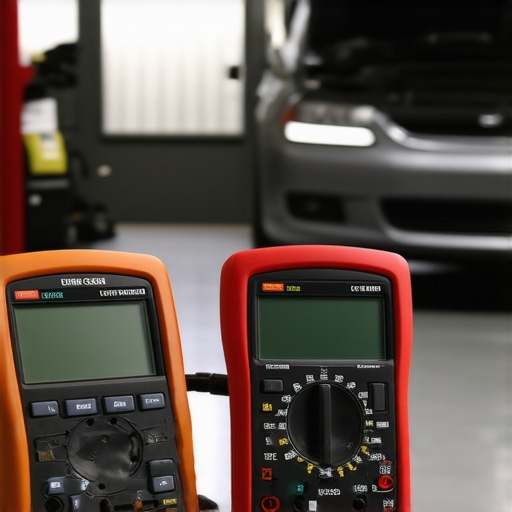
How do I maintain my diagnostic equipment for the long haul?
Keeping your gear in top shape is just as important as the car itself. According to the ISO 6789-1:2017 standard, manual torque wrenches require periodic calibration to remain within a ±4% accuracy range, a detail most home mechanics skip until they have already snapped a critical bolt. Never leave your torque wrench dialed up to a high setting; always return it to the lowest mark on the scale to keep the internal spring from losing its ‘set.’ Also, ensure your scan tool software is updated regularly. Modern cars are essentially rolling computers, and an outdated scanner is about as useful as a paper map in a GPS world. Taking care of your equipment is one of the top auto repair tips to extend your vehicles lifespan because it ensures your repairs are precise every single time. I have personally seen how a dirty probe on a multimeter can give a false reading that makes you think you have a parasitic drain when you actually just have a bad connection. The future of the auto world is moving toward predictive analytics. We are seeing the rise of AI-integrated OBD-II adapters that do not just read codes; they analyze real-time data to tell you when a part is going to fail, not just when it has already failed. Imagine knowing you need a brake service weeks in advance because your car sensed a microscopic change in piston travel speed. Before you get to that high-tech future, you must master the basics of electrical health, like learning how to tell if your car alternator is overcharging the battery. Go out to your garage right now and check your torque wrench settings—make sure you have wound it back down to its lowest setting to preserve the internal spring tension. It takes five seconds but saves you from a massive headache during your next suspension job.
Hard-Won Truths from My Years Under the Chassis
One of the most profound realizations I ever had while lying on a cold concrete floor is that metal has a memory and a temperament. When you are dealing with critical components, you have to realize that over-tightening is just as dangerous as under-tightening. I spent years thinking my calibrated elbow was enough, but after seeing how many brake service myths actually put drivers at risk, I realized that precision isn’t optional. Another ‘lightbulb moment’ was understanding that rust is a chemical enemy that requires a chemical solution, not just a bigger hammer. If you give the penetrating oil time to work, you are respecting the physics of the machine rather than fighting it. Finally, I’ve learned that the sound of a ‘click’ from a torque wrench is the most satisfying sound in the garage—it is the sound of a job done right.
Gear That Actually Belongs in Your Home Garage
If you want to move from being a ‘parts swapper’ to a real mechanic, your toolkit needs to evolve. I personally swear by a split-beam torque wrench; it doesn’t need to be wound down like coil-spring versions and stays accurate much longer. For electrical gremlins, skip the cheap test lights and get a multimeter with a high input impedance to avoid frying sensitive ECUs while you are decoding vehicle diagnostics. I also highly recommend keeping a factory service manual—not just a generic one—because the specific torque sequences for your engine head or suspension are non-negotiable. These tools are the backbone of the auto repair hacks to save money without sacrificing quality that I’ve used to keep my own high-mileage vehicles on the road. #IMAGE_PLACEHOLDER_E#
Take Control of Your Car’s Health Today
There is a unique kind of confidence that comes from knowing exactly what is happening under your hood. Whether you are performing a simple oil change or diving into complex suspension work, remember that every pro started exactly where you are—staring at a bolt that wouldn’t move. By applying these top auto repair tips to extend your vehicles lifespan, you aren’t just fixing a machine; you are building a relationship with it. Don’t let the fear of a stripped thread stop you from picking up the wrench. What is the most stubborn bolt or mechanical disaster you’ve ever had to overcome in your own driveway? Let me know in the comments below.