
I was idling in bumper-to-bumper traffic on a scorching July afternoon when I noticed that dreaded needle nudge toward the red zone. My heart sank. I had just handled a routine oil change, so why was my engine acting like it was about to melt? I remember thinking, “Maybe if I just turn the heater on full blast, I can make it home.” It worked, but I looked like I had just stepped out of a sauna by the time I pulled into the driveway. For weeks, I just kept topping off the reservoir—a classic mistake that ignored the real culprit: a radiator choking on its own internal gunk. You do not need a mechanic’s degree to figure this out, and you certainly do not need to start pulling hoses just yet.
Your Temperature Gauge is Screaming for Help
When your car starts running hot, it is easy to panic and assume the worst—like a blown head gasket or a total engine rebuild. But more often than not, the radiator is simply losing its ability to breathe. Think of it like trying to run a marathon while breathing through a cocktail straw. I once spent hundreds replacing a thermostat and a fan clutch because I did not want to admit my radiator was the issue. It was a costly lesson in decoding vehicle diagnostics the hard way. Today, I want to show you how to bypass that frustration and pinpoint a clog using just your senses and a couple of simple tools you probably already have in the garage.
Can you really spot a clog without draining the system?
I know what you are thinking: “Do I not have to see inside the tubes to know if they are blocked?” Not necessarily. While hairline cracks are obvious because they leak, internal clogs are stealthy. However, physics is on our side here. A healthy radiator should have a consistent temperature across its surface. If you have cold spots, you have a blockage. A surprising report from the Car Care Council notes that cooling system failure is actually the leading cause of highway breakdowns, yet most drivers overlook the radiator until steam is pouring from the hood. We are going to use a simple touch test and a cheap infrared thermometer to get the truth. Before we dive into the nitty-gritty, have you ever had that terrifying moment where the temp needle starts climbing and you are miles from home? Let me know in the comments! We will also look at why your heater might be acting up or why your water pump might seem like the villain when the radiator is the actual thief. Let us get into the diagnostic process that will save you a massive repair bill.
Use Your Hands to Find the Cold Spots
The most basic way to identify a blockage is through a physical temperature gradient test. A functional radiator should be consistently hot across its entire surface because the coolant is supposed to flow through every single tiny tube. I learned this the hard way on my old ’98 pickup. I felt the top hose and it was scorching, so I assumed everything was fine. Big mistake. I didn’t realize the bottom of the radiator was stone cold because the lower section was packed with what looked like wet coffee grounds—actually disintegrated gasket material and rust. While the car is warming up, carefully move your hand across the radiator fins (stay clear of the fan!). If you feel a sudden drop in temperature in one specific area, you have found your clog. This is a vital part of decoding vehicle diagnostics before you start throwing money at parts you do not need.
Stop Guessing and Use a Laser
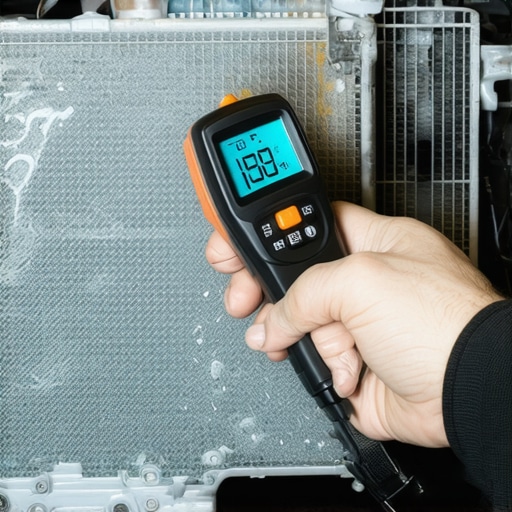
If you want to be precise, put away your hands and grab an infrared thermometer. This is the pro move. With the engine at operating temperature, scan the radiator from top to bottom and side to side. You are looking for a temperature drop of more than 20 degrees Fahrenheit between the inlet and the outlet. If you see a massive ‘cold’ patch in the middle of the core while the surrounding areas are 190 degrees, that is a cluster of blocked tubes. Using this tool helped me realize that what I thought was a cooling issue was actually related to the simple test to see if your thermostat is stuck open, saving me from a full radiator replacement. Sometimes the symptoms overlap, so having a digital readout prevents you from misdiagnosing the problem. If the temp is uniform but high, the radiator might just be dirty on the outside rather than clogged on the inside.
Check the Flow Without Removing a Single Bolt
Another trick is to look at the coolant behavior inside the filler neck or the overflow tank. When the engine is cool, remove the radiator cap and start the car. As it reaches temperature, you should see the coolant start to swirl or move vigorously. If the fluid remains stagnant or, worse, starts bubbling and erupting out of the neck, you have a flow restriction. This can often be confused with a failing pump, so knowing how to spot a bad water pump before your engine overheats is essential for comparison. In my experience, a clogged radiator often results in ‘burping’ coolant because the pressure has nowhere to go. If you decide to flush the system yourself to clear the gunk, be mindful of the hidden drain plug that ruins a diy radiator flush for many beginners. Often, the sediment settles so deeply that a standard drain won’t even touch it.
Look for the Tell-Tale Sludge
Finally, pull the dipstick and check your oil, then check the color of your coolant. If the coolant looks like a muddy milkshake or has floating bits of scale, your radiator is likely acting as a filter for all the trash in your engine block. This buildup eventually chokes the narrow passages. I once spent a whole weekend wondering why your cars heater takes forever to warm up in the morning, only to find out that the heater core and the radiator were both filled with the same brown sludge. If the fluid isn’t bright green, orange, or blue (depending on your car), it is time to investigate. Also, keep an eye out for external signs; while internal clogs are the focus, the trick to spotting a hairline crack in your radiator is often just looking for the white, crusty residue left behind by evaporating coolant near the seams.
I have seen plenty of folks try to cheat a radiator replacement by using heavy-duty chemical cleaners. In my experience, these cleaners are often too aggressive for older systems. If your radiator is already showing its age, that gunk might actually be plugging small holes that the chemical flush will rip wide open. This is a classic example of where how advanced vehicle diagnostics prevent costly breakdowns by telling you when to clean and when to quit. A study by the Car Care Council suggests that nearly 20% of vehicles on the road have cooling system issues that are misdiagnosed, often leading to owners wasting money on parts like water pumps when the radiator is the true culprit. 
Does synthetic oil actually cause leaks in high-mileage engines?
This is the debate that never ends in the shop. Many people believe that switching to synthetic oil will suddenly cause an old engine to start leaking like a sieve. The truth is a bit more nuanced. Synthetic oil does not create leaks; however, because the molecules are smaller and more uniform, they are much better at finding existing gaps that thick, sludgy conventional oil was simply plugging up. Before you make the switch, it is worth reading up on the truth about synthetic oil vs conventional in older high-mileage cars to see if your seals are up for the challenge. If you already have a small weep, synthetic will turn it into a puddle. Have you ever fallen into this trap? Let me know in the comments!
The Caliper Trap That Most Alignments Miss
Another common mistake happens during a routine brake service. If your car pulls to one side, everyone screams alignment! But if you just got an alignment and it still pulls, you might be dealing with a seized caliper or a collapsed brake hose. People often overlook this and end up frustrated when their brand-new tires start wearing unevenly. I have even seen cases where the reason your brake pads are squealing even though they are new is actually a faulty installation of the hardware or a lack of proper lubrication, not the pads themselves. It is all about decoding vehicle diagnostics with a critical eye rather than just swapping parts without a plan.
Why New Brake Pads Squeal Like a Dying Eagle
Everyone thinks squealing brakes always mean you are out of friction material. That is a common myth. In reality, brake noise is often just high-frequency vibration. If a mechanic does not use high-quality grease on the contact points or replaces the pads without servicing the rotors, you will get noise even with 90% pad life remaining. This is why understanding brake service myths busted is so important for any car owner. Don’t let a shop sell you a whole new brake job when a simple adjustment or better quality lubricant might solve the problem. Many drivers also fail to realize that an oil change is the perfect time to inspect for broader issues. If you just drain the oil and walk away, you miss the opportunity to check for metal shavings or fuel dilution, which are the real killers. Modern diagnostic techniques are not just about reading codes; they are about understanding the physical health of your fluids and preventing a minor blockage from becoming a catastrophic failure.
Stop Buying Cheap Scanners and Get a Real Multimeter
I have spent a lot of money on shiny gadgets that ended up gathering dust, but a few specific pieces of gear have saved me thousands of dollars in labor. If you are serious about keeping your car out of the shop, you need a high-quality digital multimeter. I use mine for far more than just checking if a battery is holding a charge. It is actually the secret to the secret to finding a parasitic battery drain with a simple multimeter when your car won’t start on Monday morning. I personally use the Fluke 87V because it captures fast signal changes that cheaper models miss. While everyone else is busy decoding vehicle diagnostics with expensive touch-screen scanners, I am often using a $20 vacuum gauge to see if the engine valves are seating properly. It is an old-school trick I picked up from the Motor Age Training technical manuals, which emphasize that mechanical diagnostics should never be completely replaced by electronic ones. Sometimes a simple vacuum reading tells you more about engine health than a thousand-dollar computer ever could.
How do I keep my car running for 300,000 miles?
Success at the 300k mark is not about luck; it is about a religious adherence to fluid health and data tracking. I keep a physical logbook in my glovebox for every single oil change and every odd vibration I feel at highway speeds. This is one of those essential auto repair strategies for frequent drivers that prevents minor issues from snowballing. For example, if you notice why your engine makes a tapping noise only after an oil change, you can correlate it back to a specific oil weight or filter brand you used. I also recommend doing a ‘nut and bolt’ check every six months. This involves getting under the car with a torque wrench and ensuring everything from the suspension links to the subframe is still tight. It’s part of the top auto repair tips to extend your vehicles lifespan that most people ignore until they hear a clunk. These small habits differentiate a ‘beater’ from a reliable high-mileage machine.
Prepare for the Rise of Predictive Engine Sensors
The industry is rapidly shifting toward predictive maintenance rather than reactive repairs. We are seeing a trend where vehicles will use AI-driven acoustic sensors to listen for the specific frequency of a failing bearing. I predict that within the next decade, your car will send an alert telling you how to identify a bad fuel pump before it leaves you stranded weeks before the part actually fails. Until your car can talk to you that clearly, you have to be the sensor. This means learning vehicle diagnostics explained for the average person so you can catch issues early. Even a routine brake service can be a learning opportunity. If you see uneven pad wear, you know your sliding pins are sticking, which is a common nuance mentioned in brake service myths busted. My best advice? Don’t wait for a warning light. Grab a multimeter this weekend and test your alternator’s output at the battery terminals while the headlights and AC are on. It takes two minutes and could save you a tow bill next month.
What I Learned After Boiling My Third Engine
Over the years, the biggest lightbulb moment for me was not learning how to swap a radiator but learning when to stop and look at the bigger picture. I spent far too much time ignoring that sweet smell of maple syrup from my vents, thinking it was just a temporary quirk. It was actually the radiator slowly failing. Another hard lesson I picked up is that if you see any debris in your coolant, it is not just dirty—it is abrasive and actively eating your water pump. It is also important to remember that the truth about oil additives is that they can never fix a mechanical blockage. My final realization? The radiator is the heart’s rhythm; if it skips a beat, the whole car suffers.
Gear That Actually Earns Its Keep in Your Garage
You do not need a professional shop to get professional results, but you do need a few key items that go beyond a basic socket set. I never go under the hood without my Fluke 87V; it is hands-down the secret to finding a parasitic battery drain or verifying sensor voltages. For cooling issues, a non-contact infrared thermometer is your best friend because it turns guessing into hard data. I also highly recommend the Motor Age Training manuals for anyone who wants to dive deeper into how advanced vehicle diagnostics prevent costly breakdowns. Finally, keep a simple vacuum gauge handy. It is a $20 tool that can tell you if your engine is breathing right or if you are dealing with a clogged catalytic converter.
Take Control Before the Tow Truck Arrives
Modern cars can be intimidating, but they are not magic. They are complex machines that give off specific signals through heat, sound, and smell. By practicing these essential auto repair strategies, you shift from being a victim of your car’s moods to being its master. Don’t wait for a check engine light or a plume of steam to tell you something is wrong. Trust your gut, use your tools, and stay on top of your maintenance. Whether it is a simple oil change or a complex diagnostic, you have the power to keep your vehicle on the road for the long haul.
Have you ever been stuck on the side of the road with a steaming hood because of a radiator issue? Drop your worst breakdown story in the comments below!