

I’ll never forget the first time it happened. I had just finished a beautiful three-hour cruise through the foothills, window down, music up—everything was perfect. But the moment I pulled into my garage and stepped out, I was hit with a wall of stench so foul I actually checked the bottom of my shoes to see if I’d stepped in something catastrophic. It wasn’t the shoes. It was the car. That unmistakable, nose-scrinkling scent of rotten eggs was radiating from my wheel wells like a toxic cloud. I made the classic rookie mistake of assuming it was just some weird road debris or maybe a local farm I’d passed, but that ignorance almost led to a very expensive tow truck bill. If you are experiencing this right now, don’t panic, but don’t ignore it either. We are going to get to the bottom of this sulfur mystery and save your nose and your wallet.
That Sulfur Stench Is a Cry for Help
If you’re smelling sulfur after a long haul, your car isn’t just being dramatic; it’s telling you that something in its chemical factory has gone haywire. Usually, this points straight toward your exhaust system or a battery that is literally cooking itself. When things are working right, your car processes fuel and emissions silently and without much odor. But when a component like the catalytic converter fails, it stops turning hydrogen sulfide into odorless sulfur dioxide. I remember my neighbor, Dave, once asked if I’d hit a skunk that had been eating matchsticks—that was my lightbulb moment. I had ignored a flickering light for weeks, failing to realize that decoding vehicle diagnostics early on could have saved me a massive headache. Today, I’m going to help you pinpoint exactly which part of your vehicle is failing so you don’t end up throwing money at the wrong repairs. Whether it’s a fuel pressure issue or a dying emission component, we’re going to get your garage smelling like a garage again. You might even find that the smell of rotten eggs and what it means for your exhaust is the most important warning sign you’ll ever get.
Is This Actually Going to Cost Me a Fortune?
This is the fear that kept me up that night after my drive. We’ve all heard the horror stories about the price of precious metals inside exhaust parts. It’s true that according to the Car Care Council, a neglected emission system can lead to significantly reduced fuel economy and eventual engine failure, making it one of the most critical hidden maintenance items. However, it’s not always a total disaster. Sometimes it’s just a matter of checking if your catalytic converter is actually clogged or if a simple sensor has gone rogue. Before you panic and start looking for why Charlotte junk car buyers look at your catalytic converter first, take a deep breath. We need to look at the symptoms. Did the smell start only after the engine got hot? Is your fuel mileage tanking? My own mistake was skipping the easy vehicle diagnostics checks before a road trip, which would have caught the rich-running condition that eventually cooked my exhaust. Have you ever had that panicked moment where you’re sniffing around your tires trying to figure out if your car is about to explode? Let me know in the comments, and let’s get into the step-by-step fix.
Look at Your Battery Before Buying an Exhaust
Most people jump straight to the expensive exhaust parts, but you should start with the battery. If your alternator’s voltage regulator fails, it can send too much current to the battery, essentially boiling the acid inside. This releases hydrogen sulfide gas—the exact same stuff that makes a stink bomb work. I once spent two hours crawling under a Jeep thinking the muffler was toasted, only to realize the battery was bulging like a marshmallow over a campfire. The smell was intense. You can perform the simple test to see if your battery is actually dead or if it is being overcharged. Grab a multimeter and check the voltage while the engine is running; if it’s pushing past 14.7 volts, your alternator is trying to cook your battery. Not only does this stink, but it’s a massive fire hazard. If you catch it early, you might just need a new alternator or a battery, which is a lot cheaper than a full exhaust overhaul. 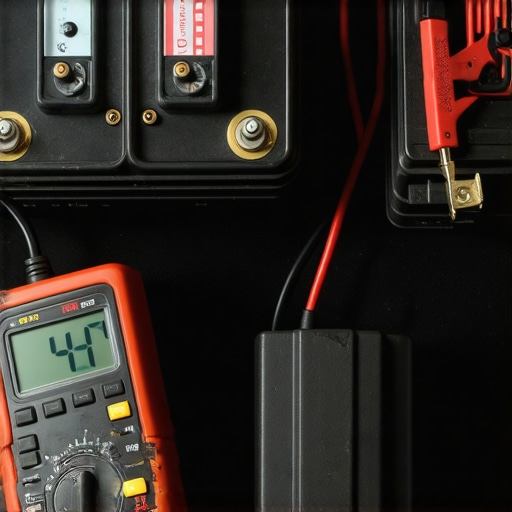
Is the Catalytic Converter Actually Melting Down?
If the battery is cool and clean, your focus shifts to the catalytic converter. This part is like a chemical oven that burns off pollutants. When it fails, it stops being an oven and starts being a clogged drain. You’ll notice the sulfur smell gets significantly worse after a highway drive because the converter is working its hardest then. I remember working on an old sedan where the floorboards felt hot to the touch—that’s a classic sign of a converter that is so clogged it’s backing up heat. You need to know how to tell if your catalytic converter is actually clogged by checking for a loss of power at high speeds. If your car feels like it’s trying to breathe through a cocktail straw when you hit the gas, the converter is likely the culprit. Utilizing how advanced vehicle diagnostics prevent costly breakdowns can help you see if your oxygen sensors are reporting the correct data or if the converter is truly dead.
Stop Your Fuel System from Overwhelming the Converter
Sometimes the smell isn’t the converter’s fault—it’s just the victim of a bad fuel system. If your fuel pressure regulator or injectors are leaking, they dump too much raw gas into the engine. The converter tries to burn all that extra fuel, gets way too hot, and starts screaming in sulfur. It’s like trying to put out a campfire with a bucket of gasoline. You should how to identify a bad fuel pump before it leaves you stranded or a leaking regulator that might be causing a rich-running condition. When I dealt with this on my own truck, I found that decoding vehicle diagnostics showed a ‘Long Term Fuel Trim’ that was way out of whack. Replacing a simple $20 sensor often stops the fuel flood and saves the $1,000 converter. Always check the fuel mixture before you blame the exhaust hardware itself.While that sulfur smell is usually an exhaust or battery issue, it is often a symptom of a deeper diagnostic trap that many drivers—and even some shops—fall into. I see it all the time: a car owner sees a ‘P0420’ code on a cheap scanner and immediately drops a thousand dollars on a new converter. Stop trusting the code reader blindly. The biggest mistake you can make is assuming the computer is telling you which part to replace; it is actually just telling you which sensor is unhappy. In my experience, a ‘bad’ converter is often just a symptom of an upstream vacuum leak or a faulty $20 sensor. Research from the Automotive Service Association (ASA) indicates that a significant percentage of sensors replaced in modern vehicles were actually functioning correctly but were reacting to an external engine fault. If you don’t find the root cause, you’ll burn through your brand-new exhaust parts in a matter of months. Have you ever replaced a part only to have the same warning light pop back up five minutes later? Let me know in the comments. 
Can Your Oil Filter Choice Actually Trigger a Low Pressure Warning?
This is a nuance that even seasoned DIYers miss. Everyone talks about the oil itself, but the filter is the silent guardian of your engine’s vitals. There is a persistent truth about synthetic oil vs conventional in older high-mileage cars that often ignores the physical hardware. Some high-flow filters lack a proper anti-drainback valve, which can lead to dry starts and that terrifying sulfur-like heat smell as the engine struggles for lubrication. I have seen specific cases where the oil filter brand that causes low oil pressure lights was the sole culprit for a dashboard warning that looked like a total engine failure. Before you let a shop tear down your oil pump, try a high-quality OEM filter first. It is an ‘advanced’ check that saves thousands.
Why Your Fresh Brake Pads Still Make Noise
Moving away from the engine, let’s talk about the ‘oops’ factor in brake service. Most people think that if they buy the most expensive ceramic pads, their car should be silent. But if you are experiencing a high-pitched squeal even after a fresh install, you likely missed the hardware. It is a common myth that the pad material is the only thing that matters for noise. In reality, vibration between the pad and the caliper is the real enemy. If you didn’t use high-temperature grease on the contact points or if you reused old, heat-cycled clips, you’ll end up wondering why your brand new brake pads are already squealing. Learning how advanced vehicle diagnostics prevent costly breakdowns applies to your ears too—listening to the frequency of the squeak can tell you if it is a fitment issue or a glazed rotor. Don’t fall into the trap of just ‘throwing parts’ at a noise; take the time to clean the hub mating surface and use proper lubrication. It’s the difference between a professional-grade repair and a frustrating weekend project.
Stop Guessing with Basic Code Readers
For years, I relied on a cheap $30 Bluetooth dongle to tell me why my check engine light was on. It was a mistake. Those basic tools only give you a snapshot, not the whole movie. To truly master your vehicle, you need to invest in a bidirectional scan tool. This isn’t just about reading codes; it’s about taking control. With a bidirectional tool, I can tell my car’s computer to turn on the fuel pump or cycle the ABS valves while I’m standing right there to watch. Understanding how advanced vehicle diagnostics prevent costly breakdowns starts with having the right data. If you’re serious about DIY, stop letting the car keep secrets from you. Being able to run an actuation test on a suspect cooling fan can save you from replacing a perfectly good motor when the real issue was a hidden relay. I personally use a tablet-based scanner that graphs live data in real-time, allowing me to see exactly when an oxygen sensor starts to get ‘lazy’ before it even trips a light.
How do I keep my car in peak condition over the next decade?
Long-term reliability isn’t about one big repair; it’s about a thousand small observations. I’ve found that the secret is a consistent ‘look-and-listen’ routine every time I change the oil. While you’re under there, don’t just drain the pan. Check the CV boots for cracks and the bushings for dry rot. Implementing top auto repair tips to extend your vehicle’s lifespan means looking for problems before they look for you. One of my favorite auto repair hacks to save money without sacrificing quality is to keep a detailed log of every fluid color and level. If your brake fluid is turning dark, it’s absorbing moisture and eating your calipers from the inside out. Following essential auto repair strategies for frequent drivers involves being proactive with things like your engine air filter. Most people wait for a service interval, but I’ve seen how a dirty engine air filter ruins your fuel economy in as little as 10,000 miles in dusty environments. According to the Delphi Technologies technical documentation, nearly 30% of supposed ‘sensor failures’ reported by DIYers are actually just symptoms of poor electrical grounding or clogged intake paths that haven’t been cleaned in years.

Get Ready for the Era of Predictive Maintenance
The landscape of auto repair is shifting fast. We are moving away from the ‘wait until it breaks’ model and toward predictive maintenance. Modern cars are already starting to use telematics to alert drivers of failing components before they actually stop working. I predict that within the next five years, AI-driven diagnostic apps will be able to listen to your engine’s idle through your smartphone’s microphone and tell you exactly which pulley is about to fail. We are already seeing oil change innovations and technologies that save your engine by monitoring the actual chemical breakdown of the lubricant rather than just counting miles. Even something as technical as a brake job is getting easier with the trick for a perfect brake bleed every single time using pressure bleeders that were once only found in pro shops. My advice? Get comfortable with the tech now. The more you understand the digital side of your car, the less you’ll fear the mechanical side. Take ten minutes today to pop your hood and just look for any sign of salt buildup or oily residue on your sensors—it’s the easiest advanced tip you’ll ever follow.
The Most Expensive Lesson My Driveway Ever Taught Me
I used to be the guy who threw a new catalytic converter at every sulfur smell, only to realize I was treating the symptom, not the disease. My lightbulb moment happened when I discovered that a faulty $20 sensor was the real culprit behind a $1,200 exhaust bill. Always test the electrical signals before you touch the hardware. If you’ve been decoding vehicle diagnostics properly, you’ll see that sensors often fail gracefully, while mechanical parts fail catastrophically. Another thing experts won’t tell you? Clean your grounds. A rusty grounding wire can make every sensor in your car look like it is broken, causing ghost smells and flickering lights that disappear the second you brush off a little corrosion.
Gear That Actually Makes Car Repair Feel Easy
If you want to stop guessing and start fixing, you need to upgrade your toolkit beyond the basics. I personally swear by a bidirectional scan tool; it is like having a conversation with your car instead of guessing its mood. For those dealing with battery stenches, the simple test to see if your alternator is killing your battery requires nothing more than a decent digital multimeter. I also highly recommend keeping a maintenance journal—a simple notebook where you track every odd sound and fluid color. Using these auto repair hacks to save money without sacrificing quality will turn your garage from a place of stress into a place of pride.
Take Control of Your Commute Again
Don’t let a strange smell or a dashboard light make you feel like you are at the mercy of a dealership. Whether you are performing a complex brake service for safety and performance or just checking a fuse, the power is in your hands. Car ownership should be about the freedom of the road, not the fear of the repair shop. By following these top auto repair tips to extend your vehicle’s lifespan, you ensure that your car stays reliable for years to come. You have the knowledge now; it is time to put it to work. Have you ever successfully diagnosed a ‘ghost’ problem that stumped everyone else? Let me know in the comments below!